On Technological Skepticism: Why we are too eager to accept and adopt new products and technologies
Essay post published on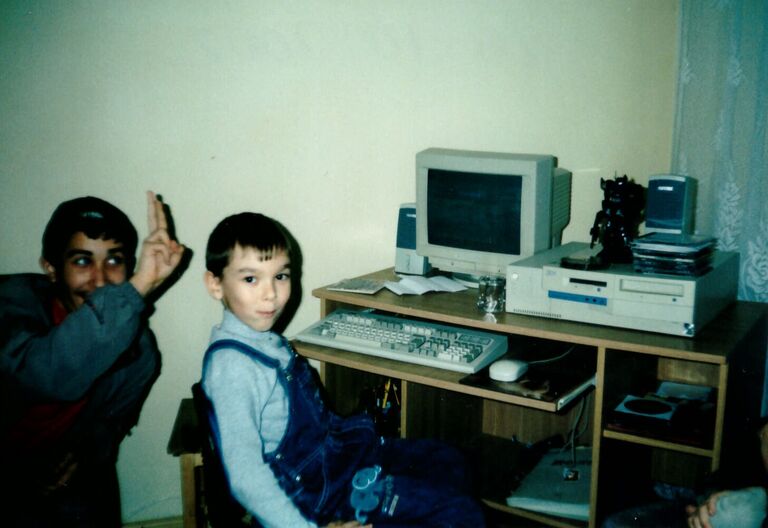
Introduction
My interest in computers was kindled early in my childhood. I am approaching the age of 31 years and thus my memories from over 20 years ago are fading. I do remember several moments relevant to my developing interest in computers:
- Together with my mother, I visited a few times a friend of hers, and played on the PC with her daughter. My favourite game that she had was DX-Ball, a Breakout type game; we also browsed the Web. These could be the first times I played a video game or went on the Internet.
- I'm not sure how they managed, but my parents got me my first computer pretty early on. I don't remember much about it, but it was an IBM PC in horizontal case placed on the desk top, (so it was truly a Desktop) and had about 20GB of storage. I remember having a gaming console too, with games such as Duck Hunt, Battle City, and Mega-Man. Of course, the console was some kind of clone, and the games were clones or at least illegal copies.
- My uncle Gabi — who is actually not much older than me — was a student at the Automatică & Calculatoare college in Bucharest and knew a lot about the technology that fascinated me. He helped me build my next PC and provided me with amazing games and software. Years later, I decided to follow behind his steps and was admitted at the same college. I knew that it wouldn't be easy, especially given that I had to be on my own away from home. Thus, he was undeniably a big influence in my personal and professional development.
- Even before beginning the formal study of computer programming and IT&C in high-school, I tried to teach on my own how to code and wrote my first programs in the 7th or 8th grades. The programs are sadly lost to time, but I remember precisely that they were GUI application made in Visual Basic 6: a program that demonstrated Kaprekar's constant, and a scoring program for Snooker.
Despite my continuous fascination with computers, the invention of the smartphone did not interest me that much. I enjoyed playing games on my friends' phones at school, but I was very reluctant to get one for myself. My last "dumb" phone was a Nokia 6500 slide, and I was pretty happy with it. Apart from handling calls and SMS, it could take decent photos, play music and radio, and wake me up in the morning. My first smartphone was an Allview which I bought not long before I left for Bucharest to begin my university studies. I think the reason was that I was moving to the big city, away from my Desktop PC and my family. I needed thus a few tools to help me, especially a maps application.
I maintained this technological skepticism ever since. To give only a few examples: I prefer wired devices to wireless ones; I have a mechanical watch instead of a smart watch; I don't participate in "social" networks; I avoid "smart" devices and home automation; I have yet to make use of the modern generative AI beyond the work environment and some isolated use cases (although I do intend to setup a local model); etc. The question is why this seemingly selective skepticism? Essentially, I think the answer lies in how I am much more conservative when it comes to weighing the benefits against the drawbacks of new technologies compared with what preceded them. That is, I place more value on aspects that most people ignore. We will perform this analysis exercise on some of the foregoing examples, but first, let's enumerate some general, common issues.
Common disadvantages of technological advances
Dependencies and obligations
Every device which is more advanced than its predecessor is in some way more complicated (either by itself or from the context of its usage), and so it depends on other devices or technologies to function. I put this first because of a very important implication: generally, technology reduces our freedom in some sense or another. An obvious example: any electrical device require power, making one dependent either on using said device in locations connected to the power grid, providing power via batteries, or otherwise generating power for it.
However, a much eloquent example is the car. Owning a car is such a hassle, I've never even came close to wanting one. As a car owner, you need to supply it with fuel, you must register it, pay taxes and insurance every year, get a driver's licence, perform regular maintenance, etc. One might argue that all this is worth it for the benefit of going faster wherever you want. However, in big cities this advantage is greatly diminished by crowding, making car users wait in line at intersections and struggle to find parking spaces.
Sometimes, introducing dependencies and restrictions is the actual purpose of the "advancement". This is the case of technologies euphemistically called "Digital Rights Management", whose sole purpose is to restrict what users can do with the hardware that they own. A famous example is how printer manufacturers added electronics to the ink cartridges so that the printer can refuse those not bearing the digital signatures approved by them. To point out how ridiculous this is, Cory Doctorow made a hilarious comparison to toasters that reject "Unauthorized Bread".
Weakening of skills
Every technological advance makes our lives easier — or at least makes us believe so. This renders more and more of our skills useless, leading to their atrophy. This is especially dangerous for intellectual abilities. Sure, some skills are not really that important to our character, such as performing difficult calculations in our head or on paper. On the other hand, relying on the latest generative AI services to do our work not only weakens or own ability to do so, but also prevents cognitive progress.
Anxiety
New technology makes things faster, enables us to do more stuff, more work, and at a bigger scale. This increase of the rhythm of life, in turn, leads to anxiety, as we are forced to juggle more responsibilities and to raise to ever stricter standards and bigger expectations. Smartphones made us connected to the whole world anywhere and at any time and thus we are expected to always be available and informed. At work we are expected to be more and more productive and assume multiple roles.
Additionally, we are constantly bombarded and encouraged to adopt more and more tech. As I was writing this, my phone notified me that my Android has new features and that I should check them out. Windows users are incessantly nagged to connect their account to OneDrive and to get Office 365, so all their files can automatically go the cloud making them even more dependent on Microsoft. The marketing/advertisement industry and the big tech platforms developed increasingly invasive and pervasive methods to persuade people to consume their garbage for the sake of profits; be it junk food, stupid and insecure devices to automate your home by connecting your fridge and light bulbs to the Internet, or subscriptions to software "services" (Saas) instead of programs which can very well run on your own machine.
Computers and smartphones
Coming back to computers (desktops and laptops) vs. smartphones, let's start by comparing them with what came before.
Computers as general purpose computing devices don't really have a single predecessor, as they have many different uses. However, I think it's reasonable to say that the main, most general use case is information processing. For most of modern and even ancient history, there was paper, cardboard, and various mechanical devices that helped us create written works and perform calculations faster. Compared to these now ostensibly "ancient" technologies, a computer is a revolutionary, miraculous invention that allowed us to process information at massive scales, and opened up endless possibilities, like digital graphics and video games. Basically everything intangible can be encoded as information in some way, making it subject to realm of computation. The downsides are obvious, but in my view, they don't tip the scales: they do need electricity, they are composed of extremely sophisticated electronics, some of which can only be built by a few companies in the world, and they require a connection to the Internet to access the vast troves of information stored online.
Smartphones, on the other hand, are simply a cellphone and a tiny computer combined (we can also include a camera for good measure). They are a worse cellphone because they are bigger and more uncomfortable to hold to your ear or keep in your pocket. They are also a much worse computer because they have such a small screen, they don't have a real keyboard, you can't change their internal hardware or easily connect peripherals. It is very difficult to change even the operating system in the event that you want to escape the tight grip of the Apple–Google duopoly. You have to accept all this to get only one but sometimes important benefit: mobility. You can't take your desktop with you on vacation to send pictures to your grandmother, and even a laptop is inconvenient to carry around. Hence using a smartphone is justified only to the extent we require mobility. If I'm in another country, sure, I will buy tickets and look up information online on the smartphone, but squinting at a tiny screen on the street if I can wait to get home where I have a full-blown desktop is ridiculous.
There is also the argument that the ubiquity of smartphones made the young people today fall behind when it comes to digital skills, since the user interface on a phone hides a lot of the complexity of a computer environment. For instance, the notion of a hierarchical file system is pretty much absent; you don't really work with files and folders on a smartphone.
Conclusion
We are much too eager to accept and adopt new products and technologies, giving next to no regard to their negative consequences. I hoped I offered you some inspiration to better apply your faculty of deliberate choice (prohairesis). The foregoing considerations and examples can even be generalized to the adoption of new methods or new ways of getting something done. For instance, food or grocery delivery services are not really a new technology, but more of a new kind of business. In any case, the questions we should ask ourselves are:
- Why would this be better than what I have now?
- Do the advantages correspond to real needs that I have?
- What are the disadvantages?
- Are these downsides worth the hassle of switching from the old thing?
- Are these needs so important that I have to accept these downsides?
Related articles